
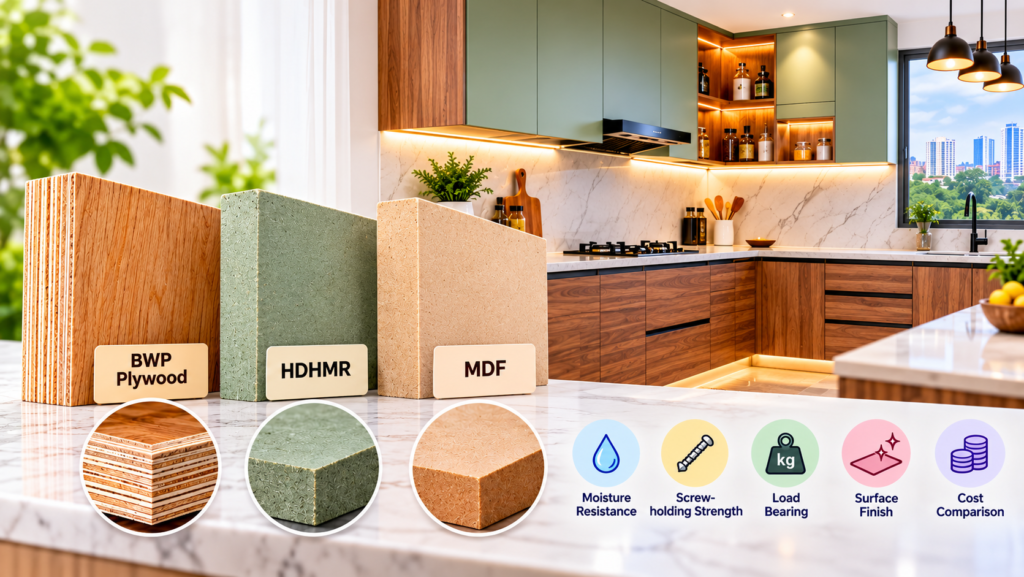
Picture this. Your new apartment has just been handed over, the quotation looks great, and the kitchen shutters are a gorgeous matte oak. Then the first monsoon arrives. Eighteen months later, the cabinet under your sink has a swollen bottom edge and the laminate is lifting at the corner. Nothing about the design was wrong. The material hiding inside the cabinet was.
That is why the best material for modular kitchen cabinets matters more than the colour you pick. In Bangalore homes, with daily steam, RO and sink leaks, and monsoon humidity, the board behind the finish decides whether your kitchen looks new in year ten or tired in year three.
This guide compares the three materials in almost every quotation: BWP plywood, HDHMR and MDF. By the end, you will know which belongs where.
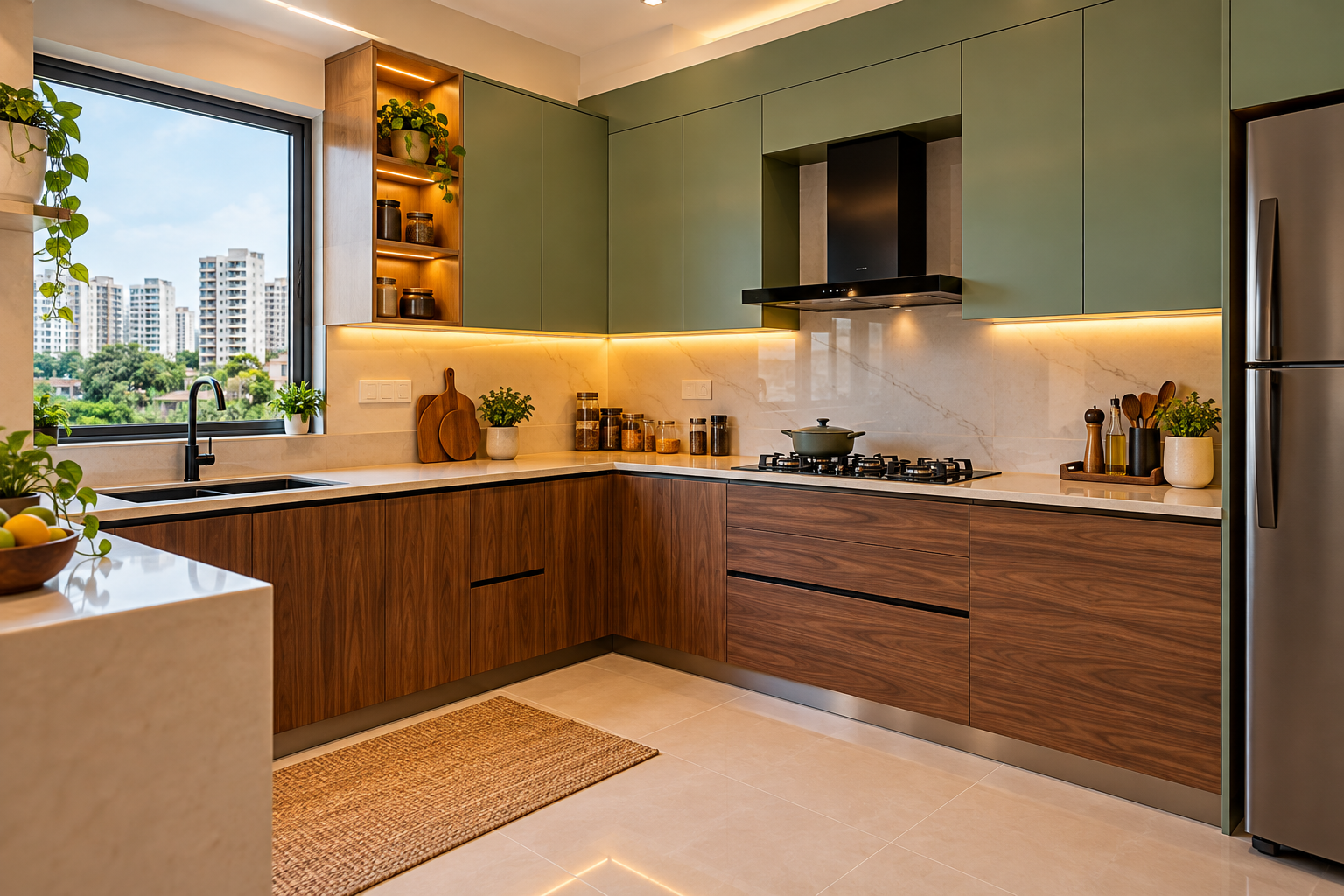
The Carcass Matters More Than the Shutter
A modular kitchen has two layers:
- The carcass (box): the hidden structure of base units, wall units and shelves. This is where BWP, HDHMR or MDF is used.
- The shutter and finish: the visible laminate, acrylic or PU fronts, plus hardware.
Most homeowners spend hours on finishes and minutes on the carcass. Yet it carries your steel vessels, mixers and masala boxes, and faces moisture every day. A beautiful finish on a weak carcass is like a lovely saree over loose stitching. It will not hold.
Three things stress a kitchen cabinet: moisture and steam (sink, hob, RO unit), weight (cookers, grocery storage) and daily wear (hinges and drawer screws used hundreds of times a month).
What Is BWP Plywood?
BWP stands for Boiling Water Proof. It is made of thin hardwood veneers laid in alternating directions and bonded with phenolic resin. Genuine marine-grade BWP carries the IS 710 certification from the Bureau of Indian Standards.
Strengths: handles prolonged water contact without delaminating, holds screws firmly so hinges and channels stay tight, carries heavy loads, and lasts long when edges are sealed.
Limits: it is the costliest of the three, the grain can show through so it is finished with laminate or acrylic rather than routed, and quality varies. A “BWP” sticker is not proof, so ask for brand, thickness and certification.
Best for: under-sink units, base cabinets, the hob zone and any heavily loaded cabinet.
What Is HDHMR?
HDHMR stands for High-Density High Moisture Resistant board, made of compressed wood fibres, resin and wax pressed into a very dense, uniform sheet.
Strengths: a flawlessly smooth surface for laminate and PU, can be routed for grooves and profiles, good moisture resistance, and usually priced below BWP.
Limits: it is moisture resistant, not waterproof, so a constant leak will eventually damage it. Screw-hold is lower than plywood, and cut edges need proper sealing.
Best for: wall cabinets, dry-zone tall units and shutters needing a smooth or routed finish.
What Is MDF?
MDF, or Medium Density Fibreboard, is made of fine wood fibres and resin. It is smooth and easy to shape, which is why it suits decorative panels, wardrobe shutters and TV units.
In a kitchen, the honest truth is that standard MDF absorbs water, swells and does not recover. Once an edge swells, the laminate peels and no repair truly fixes it. Moisture-resistant (MR) MDF does a little better, but still falls short of BWP or HDHMR in a working Indian kitchen.
Best for: decorative panels and dry-area furniture, not sink, hob or base carcasses.
BWP vs HDHMR: Which Is Better for Your Kitchen?
The honest answer: it depends on the zone. Each wins in a different part of the kitchen.
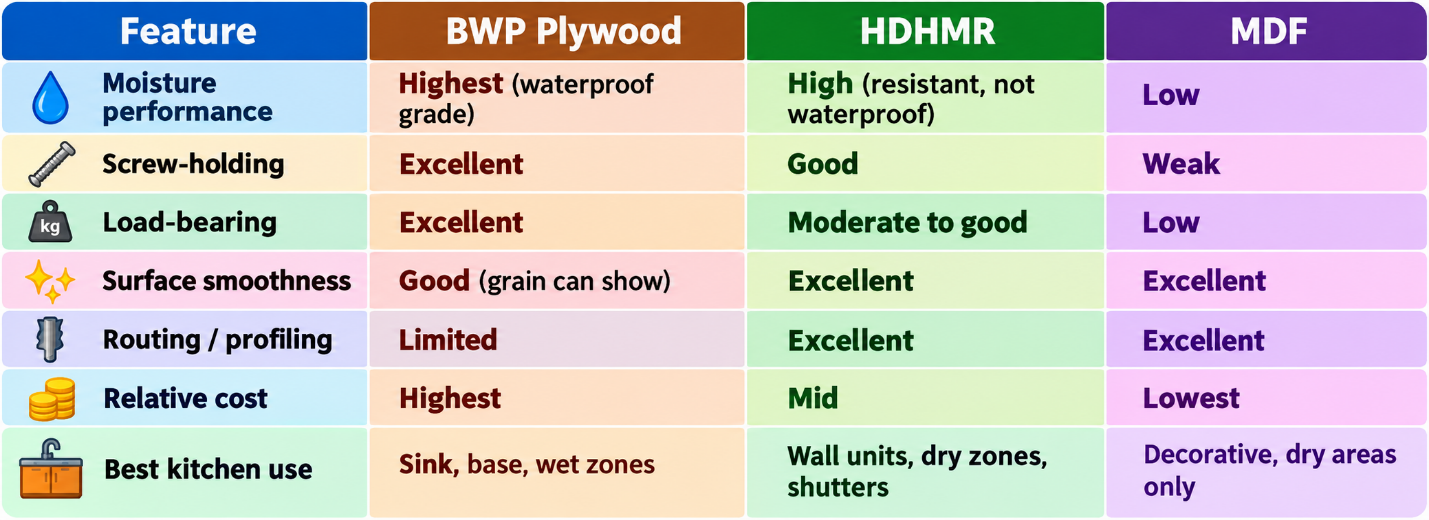
In simple terms: if a cabinet will meet water, steam or heavy weight, choose BWP. If it sits above the counter and needs a flawless finish, HDHMR is a smart, value-friendly choice.
MDF vs Plywood Kitchen: Is the Saving Worth the Risk?
Many quotations quietly use MDF or particle board for the carcass to bring the number down. On day one you will not see the difference, because the finish looks identical. It shows up after a monsoon or two. When weighing MDF vs plywood kitchen options, ask:
- Will this cabinet ever see water? If yes, MDF is a gamble.
- Will it carry heavy items? Plywood holds screws and weight far better.
- How long will I stay? Over 10 years, the small saving on MDF rarely pays off.
A kitchen is also expensive to redo. Replacing swollen base units means lifting the countertop, removing appliances and disturbing tiles, a far bigger bill than choosing the right board at the start.
Choose Modular Kitchen Material Zone by Zone
You do not need the costliest material everywhere. Match the board to the job:
- Sink and dishwasher zone: BWP plywood, always.
- Hob zone and base cabinets: BWP plywood, as they face heat, steam and your heaviest cookware.
- Wall cabinets and lofts: HDHMR, as they stay drier and carry lighter loads.
- Tall units and pantry: HDHMR or BWP, depending on storage and budget.
- Decorative and open display panels: HDHMR or MDF.
We walk through this zone-wise plan with every homeowner at the 3D design stage, so you see exactly where each material goes before anything is manufactured.
Want to see what each material does to your budget? Try our free cost estimator for a transparent, no-hidden-cost estimate.
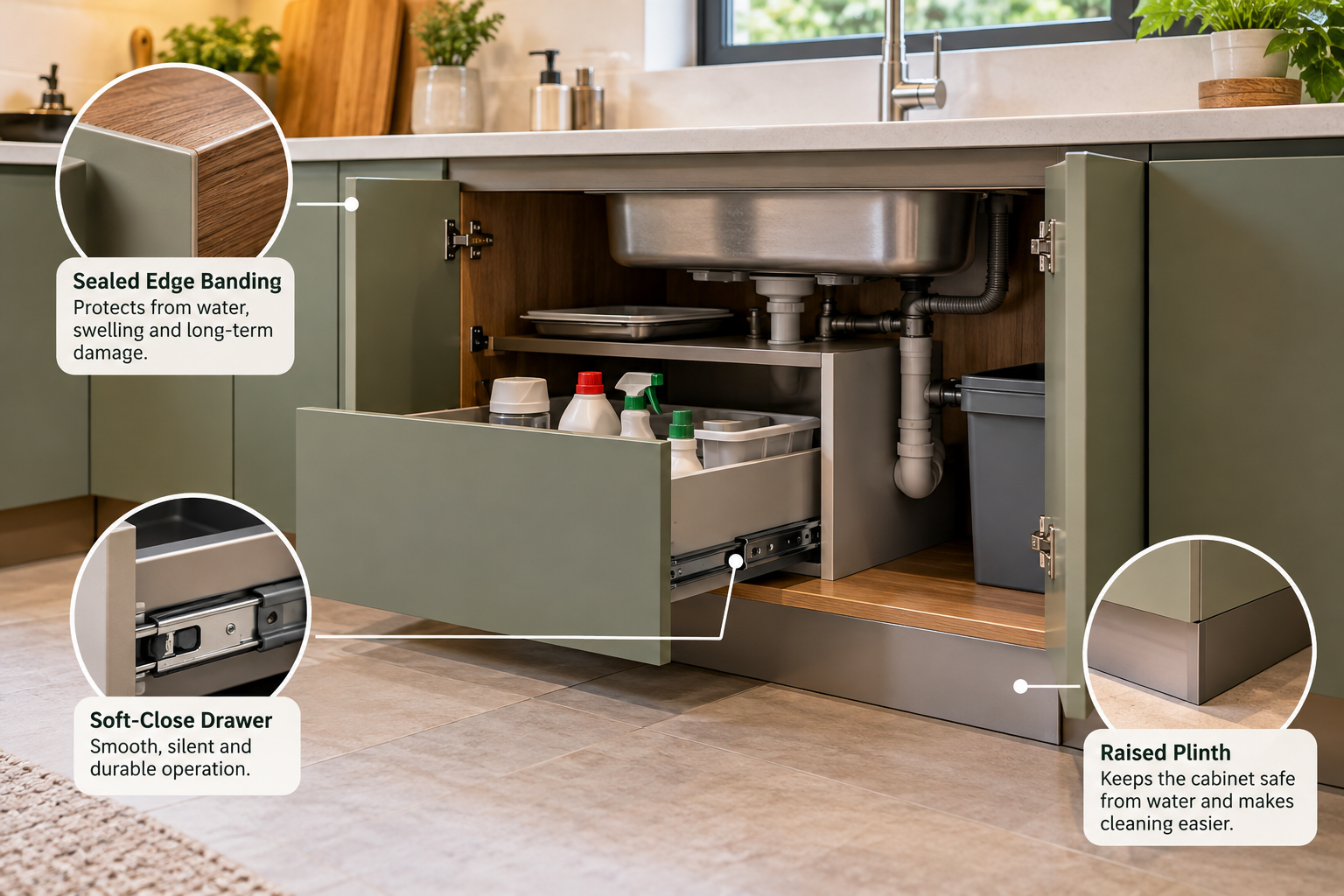
Details That Matter as Much as the Board
- Edge banding: exposed edges are where moisture enters, so insist on tight sealing, especially on base units.
- Raised plinth: cabinets sitting directly on the floor trap mopping water.
- Hardware: reputed brands like Hettich or Ebco make everyday use smoother and last longer.
- Finishes: branded laminates such as Merino and Asian Paints finishes protect the surface.
- Written specification: your quotation should name the board brand, grade and thickness for each cabinet, not just say “plywood” or “engineered wood”.
Avoiding the “Material Switch” Trap
A common complaint is the gap between what was promised and what was installed. To protect yourself, get the board brand, grade and thickness in writing, ask for the 3D design and material sheet before production, and confirm the warranty covers service at your home, not just replacement parts.
At My Insta Spaces, you see realistic 3D visuals and the full material list before manufacturing begins. We work with branded material partners such as Greenply, Merino, Aristo, Ebco and Hettich, and every kitchen goes through 146 quality checks during production. It is backed by a flat 10-year warranty and India’s first and only on-site service warranty.
So, What Is the Best Material for a Modular Kitchen in Bangalore?
For most Bangalore homes, a combination works best:
- BWP plywood for the sink, hob and base carcasses
- HDHMR for wall and tall units, for a smooth finish at a friendlier price
- MDF only for decorative, dry-area elements, if at all
If budget forces one choice, protect the base units with BWP first. If you plan to stay many years and want zero compromise, BWP throughout is the safest long-term investment.
Ready to Plan a Kitchen That Lasts?
Our designers will plan the right material for every zone, show it in 3D, and give you a clear quotation with no hidden costs.
Book a free consultation or explore our modular kitchen designing services in Bangalore. Call +91 97414 24332 or write to co*****@***********es.com.
We design modular kitchens across Bangalore, including HSR Layout, Koramangala, Indiranagar, Whitefield, Sarjapur Road, Jayanagar, Yelahanka, Kalyan Nagar and HBR Layout.
Frequently Asked Questions
Which is the best material for modular kitchen cabinets in India?
BWP (IS 710) plywood is the most reliable for base units thanks to its waterproof grade, strength and screw-holding. HDHMR is a good-value choice for wall units and dry zones. Using each in the right zone gives the best results.
What is the difference between BWP and HDHMR?
BWP is plywood made of layered hardwood veneers bonded with waterproof resin. HDHMR is an engineered board of compressed wood fibres. BWP handles water, weight and screws better, while HDHMR gives a smoother, routable surface.
Is HDHMR waterproof?
No. It is highly moisture resistant and handles humidity and occasional splashes, but constant water exposure, such as a leaking sink pipe, can damage it. For wet zones, choose BWP.
Is MDF good for a modular kitchen?
Standard MDF is not recommended for kitchen carcasses, especially near the sink and hob, as it absorbs moisture and swells. It can work for decorative, dry-area elements.
Is plywood better than MDF for kitchens?
Yes, for a working kitchen. Plywood, especially BWP, resists moisture better, holds screws more firmly and bears more weight.