What Is Space Planning in Interior Design and Why It Matters for Modern Homes
You spent months choosing the perfect sofa. You painted the walls a warm, inviting shade. You followed every home layout design idea you found online. And yet the room still feels off. Something is missing. Something invisible. That something has a name: space planning in interior design. And it is the single most important factor that separates a house that looks beautiful in photos from a home that genuinely feels like yours.
Space planning is the art and science of arranging every element in a room furniture, traffic flow, light, proportion, and function so that the space works for the people living in it. It is not just about aesthetics. It is about how a room breathes. How it moves. How it makes you feel the moment you walk in. Without it, even the most expensive decor can feel disconnected, awkward, and incomplete.
In 2026, modern homes demand more from their interiors than ever before. Smaller urban apartments must function as offices, gyms, and living spaces all at once. Larger homes need intelligent zoning to avoid cavernous emptiness. And everywhere in between, homeowners are discovering that good interior design is not about filling a space it is about understanding it.
1. Top Interior Design Mistakes That Make Your Home Feel Empty and Unfinished
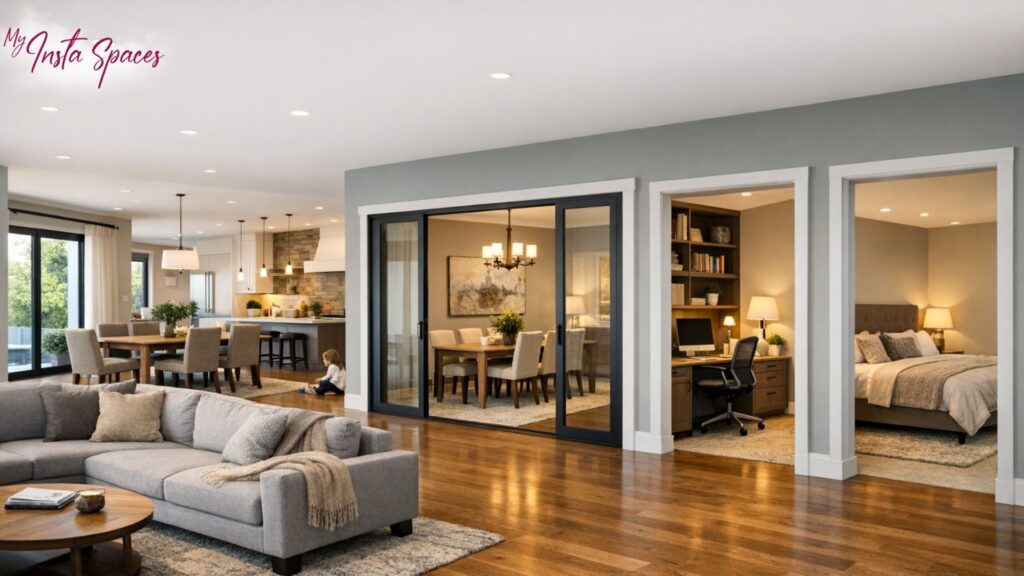
The most common interior design mistakes are rarely obvious. They do not announce themselves. They quietly undermine every good decision you have made and they almost always trace back to poor spatial logic.
One of the biggest errors is choosing furniture that is too small for the room. A delicate coffee table in a large living room does not create a minimalist effect it creates emptiness. The furniture appears to float, unanchored, in a space it cannot hold. Scale matters enormously in space planning in interior design, and mismatching scale is one of the fastest ways to make even a well-furnished room feel unresolved.
Another widespread interior design mistake is ignoring traffic flow. When furniture is placed without thought for how people move through a room, the space becomes physically and psychologically uncomfortable. You unconsciously sense the obstruction even when you cannot name it. The result is a room that feels busy and difficult despite looking clean on paper.
Poor lighting zoning is the third culprit. Relying on a single overhead light for an entire room flattens the space and eliminates the depth that layers of light create. Ambient, accent, and task lighting working together give a room dimension the kind that makes spaces feel rich, intentional, and alive.
2. How Smart Space Planning Improves Functionality in Small and Large Homes
The rules of space planning in interior design apply equally to compact city apartments and expansive independent homes but the strategies shift depending on what you are working with.
In smaller homes, smart space planning is about creating perceived volume without adding square footage. Multifunctional furniture beds with built-in storage, dining tables that double as workstations, sofas with pull-out configurations transforms tight rooms into highly capable living environments. Strategic mirror placement amplifies natural light and creates the illusion of depth. Vertical storage draws the eye upward, making ceilings feel higher and rooms feel more generous.
In larger homes, the challenge reverses. Without thoughtful zoning, spacious rooms can feel cold, disconnected, and hard to inhabit comfortably. Smart home layout design ideas for large spaces involve creating defined activity zones a reading corner anchored by a rug and a floor lamp, a conversation area centered around a focal point, a dining zone that feels warm and contained rather than marooned in open space. Each zone must feel complete in itself while remaining visually connected to the whole.
3. The Psychology of Space: Why Furniture Layout Affects Comfort and Mood
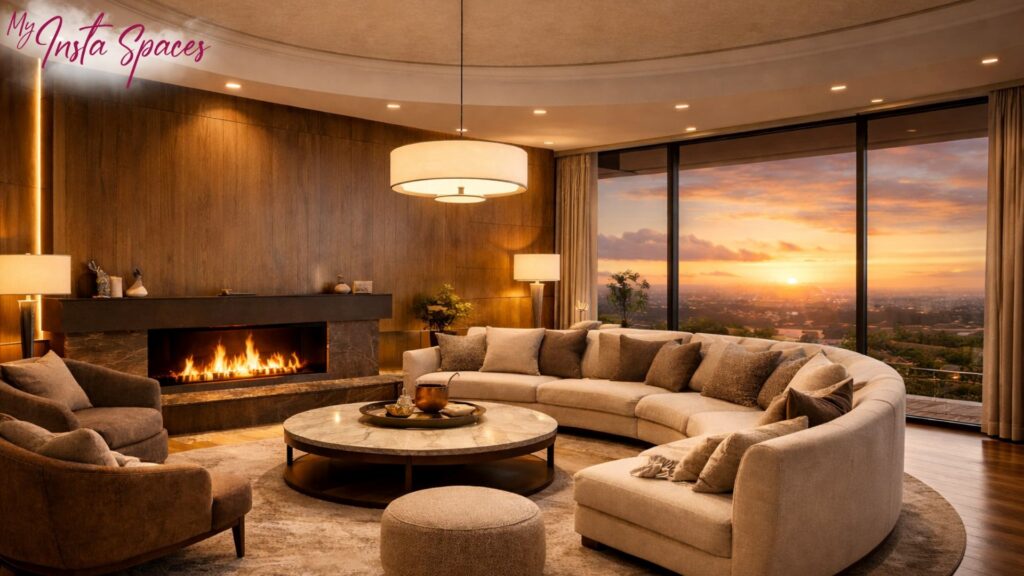
Interior design is not just visual. It is deeply psychological. The way furniture is arranged sends constant signals to your brain about safety, comfort, social connection, and status often without you realizing it.
Rooms where seating faces a wall rather than a view or a focal point trigger subtle unease. Human beings are instinctively uncomfortable with their backs exposed to open space a phenomenon rooted in our evolutionary need to monitor our environment. Positioning seating so that occupants face inward toward each other and toward the room’s main feature creates an immediate sense of security and belonging.
Circular and curved arrangements encourage conversation and warmth. Rigid, angular layouts signal formality and distance. The best home layout design ideas take these psychological cues seriously designing rooms that feel emotionally correct, not just visually balanced. When a space is planned with human psychology in mind, it does not just look right. It feels right. And that feeling is what transforms a house into a home.
4. Open Floor Plan vs Structured Layout: Which Interior Design Works Best?
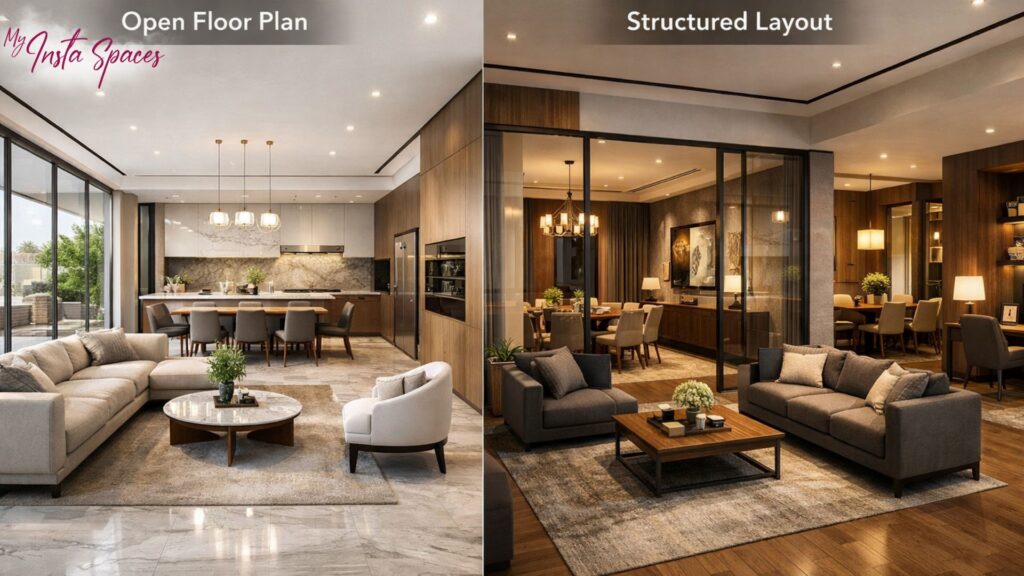
The open floor plan revolution gave modern homes a sense of freedom and light that traditional compartmentalized layouts could not match. But it also introduced a new set of space planning challenges that many homeowners are still navigating.
Open plans excel at creating social connectivity and visual spaciousness. They are ideal for families with young children, for those who entertain frequently, and for compact spaces that need to feel larger. But without disciplined space planning in interior design, open plans become chaotic. Without walls to define zones, every design decision carries double the weight. A misplaced rug or an oversized piece of furniture can disrupt the entire visual logic of the space.
Structured layouts offer clarity and containment. Separate rooms allow for acoustic privacy, purposeful decoration, and clear functional identity. A home office feels like a workspace. A dining room feels like a place of gathering. A bedroom feels genuinely restful. The psychological benefits of defined spaces are significant particularly in homes where multiple people work, study, and relax under the same roof.
The answer to which works best is never universal. It depends on your lifestyle, your family’s daily rhythms, and the specific geometry of your home. The wisest approach is a hybrid using open planning where social flow benefits from it and structured zoning where privacy and purpose demand it.
5. Professional Interior Design Tips to Create a Balanced and Luxurious Home
Creating a home that feels genuinely luxurious does not require an unlimited budget. It requires precision, intention, and the kind of intelligent design thinking that understands how space planning in interior design and visual balance work together to create an experience rather than just a room.
Start with a focal point in every room. A fireplace, a feature wall, an oversized piece of art, or a bold architectural element gives the eye somewhere to land and the room a sense of narrative. Everything else should support that focal point not compete with it.
Layer your textures deliberately. Luxury is felt as much as it is seen. A smooth marble surface next to a nubby linen cushion next to a warm timber floor creates a sensory richness that elevates a room beyond its price point. This is one of the most transformative home layout design ideas that professional designers use consistently.
When it comes to color, restraint is a luxury. A tightly curated palette of two or three tones with one dominant, one complementary, and one accent creates sophistication that eclectic, multi-color schemes rarely achieve. And always, always invest in quality where it matters most: the sofa, the bed, the dining table. These are the pieces that define a room’s character and carry the weight of daily life.
This is where My Insta Spaces brings its expertise to life. As Bangalore’s leading interior design studio for modern homes, My Insta Spaces translates these professional principles into spaces that are deeply personal, functionally brilliant, and aesthetically bold. Every project begins with space planning because that is where every great interior begins.
Transform Your Living Space with Expert Space Planning and Functional Interior Design
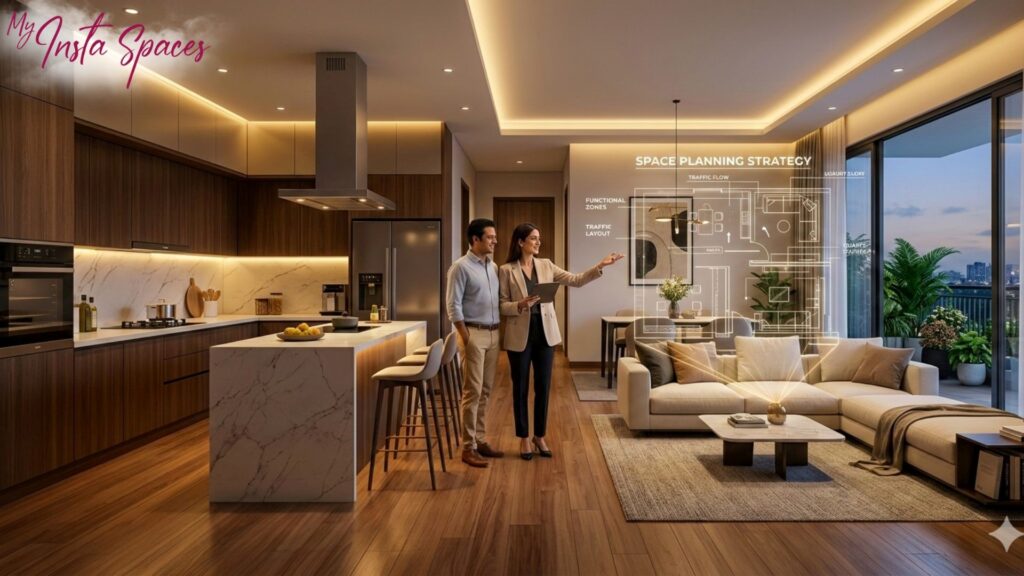
Your home is the most personal space you will ever inhabit. It deserves more than decoration. It deserves design the kind that starts with understanding how you live, how you move, and how you want to feel every single day. Space planning in interior design is not a technical detail reserved for architects and design professionals. It is the foundation of every home that truly works and every home that genuinely feels like a sanctuary.
The secrets most designers do not share are not hidden out of selfishness. They are simply the product of experience the kind that comes from designing hundreds of homes and understanding what truly makes a space come alive. Scale, flow, psychology, light, proportion, and purpose: these are the real ingredients of a beautiful interior.
My Insta Spaces is Bangalore’s creative, bold, and youth-driven interior design studio built for modern homeowners who refuse to settle for ordinary. From compact city apartments to expansive independent homes, My Insta Spaces delivers customized, budget-friendly, and beautifully executed interior solutions that begin with precision space planning and end with spaces you will never want to leave. Every room is a story. My Insta Spaces makes sure yours is worth telling.
Frequently Asked Questions
Q1: What is space planning and why is it important in interior design?
Space planning is the process of organizing furniture, traffic flow, functional zones, and visual elements within a room to maximize comfort, usability, and aesthetics. It is the structural logic behind great interior design the part that makes a room feel right even before you consciously notice why. Without it, even beautiful decor fails to create a cohesive, livable space.
Q2: Why does my room still feel empty even after adding furniture?
This is one of the most common experiences homeowners have after decorating. The culprit is almost always a mismatch between furniture scale and room size, poor furniture placement that ignores traffic flow, or the absence of layered lighting and texture. A room needs correctly scaled pieces, defined zones, and enough visual depth to feel full and intentional rather than scattered.
Q3: What are the most common interior design mistakes people make?
Choosing furniture that is too small for the space, placing all furniture against the walls, using a single overhead light source, ignoring traffic flow patterns, and failing to create a clear focal point are among the most frequent errors. Each one disrupts the spatial logic of a room and creates that difficult-to-define feeling of something being off.
Q4: Is open floor plan or structured layout better for a modern home?
It depends on your lifestyle and the specific characteristics of your home. Open plans work brilliantly for social, family-oriented living and for creating visual spaciousness in smaller homes. Structured layouts offer better acoustic separation, clearer functional identity for each room, and stronger psychological boundaries between work and rest. Many of the best modern homes use a thoughtful hybrid of both approaches.
Q5: How do professional interior designers create a luxurious feel without overspending?
Professional designers focus on scale, proportion, and focal points before spending on decor. They invest in quality for high-use pieces like sofas and beds, use layered lighting to create depth and warmth, and maintain a disciplined color palette rather than chasing trends. The result is a home that feels expensive not because of what was spent, but because of how every decision was made with intention and intelligence.